What is a Sample Book and why do you need one?
Sample books are a very useful tools both when you're learning to tat as well as when you are a proficient tatter.
In short a sample book is a place where you keep samples of all the tatting techniques you've learned along with instructions on how to tat them.
Why would you need a sample book? When you're new to tatting as you learn the basics you'll find it helpful to have the techniques you're learning explained in your own words. If you forget a technique you can simply look in your book to refresh your memory and even look at an example you tatted yourself.
As you progress in your tatting journey, you'll find yourself learning many amazing techniques beyond the basics. Many of these techniques may not be commonly used so over time you might forget how to do them. This is again another benefit to having a sample book.
A Designer's Resource
If you become a tatting designer you will find a sample book to be quite important to your design process.
When you're looking to add something different to an element of your design ideas are right at your fingertips! Simply pop open your sample book and peruse through to find an uncommon or forgotten technique that you could reintroduce to tatters through your pattern.
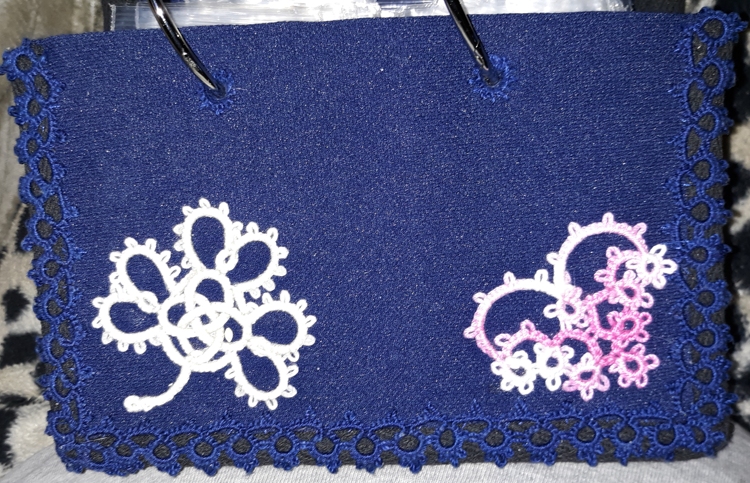
Here's a peek at my first sample book. Made from cardboard, index cards and binder rings.
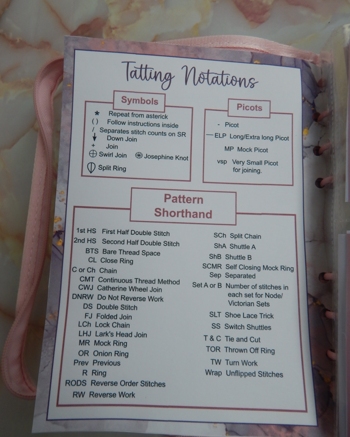
On the inside cover of my new sample book I added a table of tatting notations.
Last year during the online tatting class our teacher Tamie suggested using a jewelry binder for keeping your samples. I really liked the idea so I imnediately purchased one. Rather than transfer everything over to the new binder, I decided to re-tat all my samples and re-write the instructions. I'm very happy I did and I am tickled with how my book turned out.
I reorganized the book into categories as well as alphabetizing it.
Here's a list of my categories and samples.
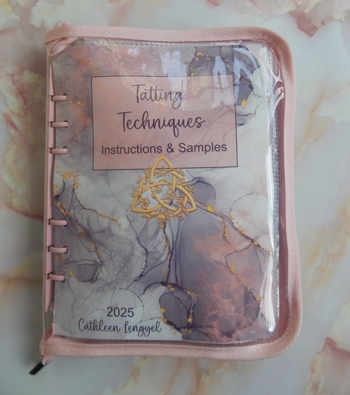
Front Cover
Inside Cover
Rings
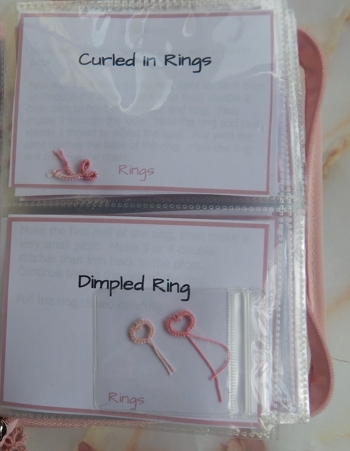
- Curled Rings
- Dimpled Rings
- Folded Rings
- Half Rings
- Half Moon Split Rings
- Interlocking Rings
- Josephine Knot/Ring
- Layered Rings
- Leaf Ring
- Loop Tatted Ring
- Maltese Ring 1
- Maltese Ring 2
- Maltese Ring 3
- Onion Rings
- Self Closing Mock RIngs
- Single Shuttle Split RIngs
- Spiral Rings
- Split Rings
- Square Rings
- Thrown Rings
Chains
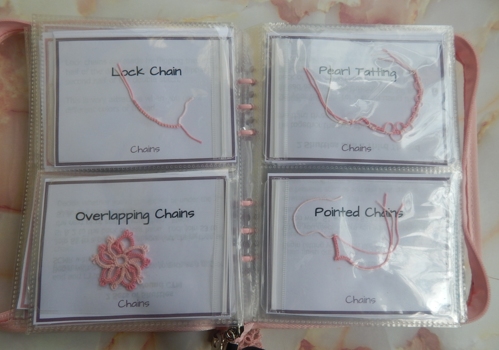
- Floating Chains
- Josephine Chains
- Lock Chains
- Overlapping Chains
- Pearl Tatting
- Pointed Chains
- Split Chains
- Victorian Sets (Node Stitch)
- Zig Zag Chains
Joins
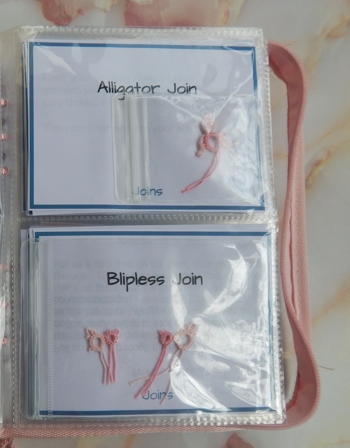
- Alligator Join
- Blipless Join
- Catherine Wheel Join
- Folded Join
- Joining to 2nd side of a split ring.
- Lark's Head Join
- Lock Join
- Onion Ring Join
- Slope and Roll
- Swirl Join
- Up & Down Joins
Picots
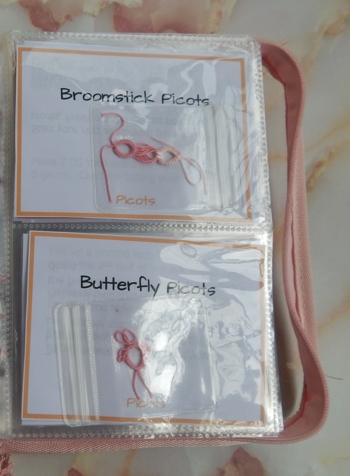
- Broomstick Picots
- Butterfly Picots
- Celtic Picots
- Daisy Picots
- Dancing Picots
- Dizzy Picots
- Dot Picots
- Double/Triple Picots
- Downward Picot
- Gathered Picots
- Graduated Picots
- Herringbone Hook-up
- Ikuta Picots
- Interlocking Picots
- Knotted RIng Picots
- Layered (Ruffled) Picots
- Loop Over Picots
- Mimosa Knot Picots
- Mock Picot
- Mrs. Mee Picots
- Ring On Picots
- Rolled Picots
- Tuft Picots
- Twisted Picots
- Vapor Picots
- Venetian Picots
- Wide Picots
- Woven Picots
Beads
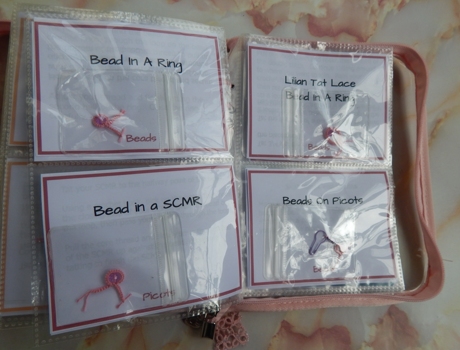
In the beads section I have small samples tatted with the different ways to tat with beads on the shuttle or ball threads.
Miscellaneous
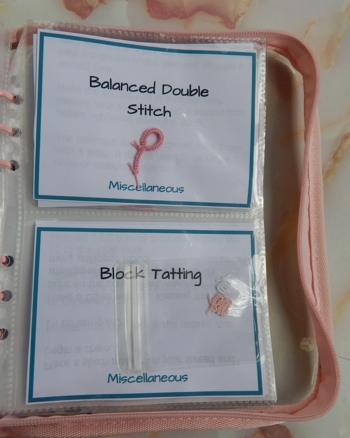
This is the section where I place any notes that don't require a tatted piece or simply don't fit in any other category. It also contains chains of thread in different sizes for noting stitch counts per inch.
As you can see, keeping a Sample/Technique book can be very handy! We don't use most of these techniques every day, so it's good to have a refresher handy so we remember how to work them. If you don't have one yet go get started on one and see how beneficial it can be!
Until Next time,
Keep Creating!
Cathleen